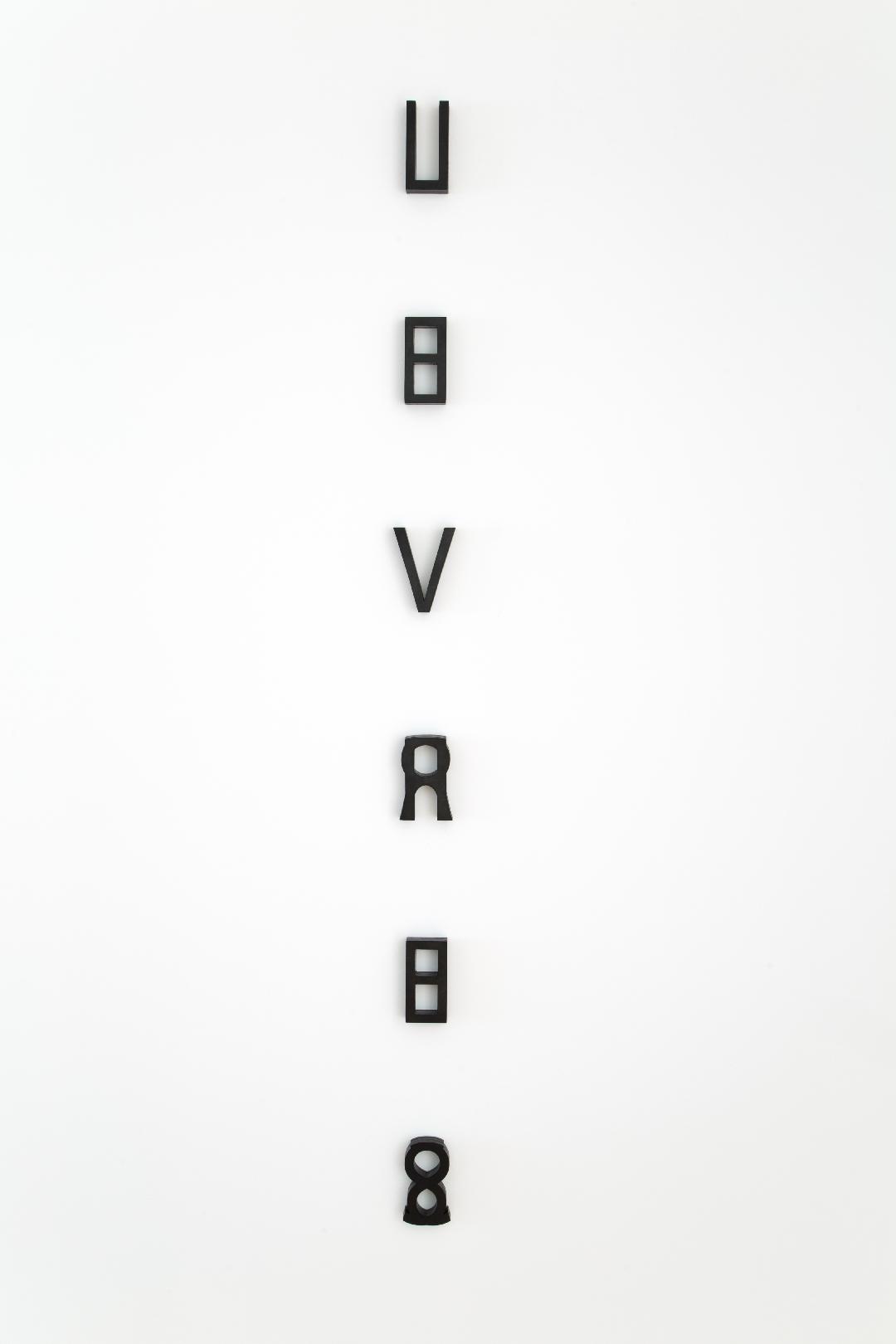
The Unreadables
Curated by François de Coninck, The Unreadables explores asemic writing through a selection of modern and contemporary works that confront us with the physical dimension of writing—its material aspect, in other words. The signs that compose these works possess all the attributes and visual appeal of writing, yet they are stripped of the units of meaning normally attached to it. Meaning—that immaterial component of writing—evaporates before our eyes.
Légende visuel: Florian Kiniques, LEVRES, 2019 Bois, encre typographique. 170 x 10 x 3 cm.
Gérard Berréby, Jacques Calonne, Denmark, Emmanuel Dundic, Christian Dotremont, Bertrand Flachot, Jack Keguenne, Florian Kiniques, Juliette Lempereur, Atelier Matador, Jean-Pierre Maury, Henri Michaux, Eugène Savitskaya, Harald Stoffers, Laurent Sfar, VOID, Philip Witman, Neo Zha
Introduction
“At the end of the day, who writes? All living beings, without exception, write on things and among themselves; the things of the world write upon one another, just as dark planets, glittering stars and luminous galaxies do.” [1]
This exhibition invites us to encounter traces, signs and characters in their sensory and intimate dimension. The aim is no longer to decipher or understand them according to the clear and distinct categories of language, but rather to make ourselves receptive to what, within the sign, precedes or exceeds all meaning: its rhythm, its materiality, its presence.
Twenty-one artists – the “Unreadables” – address us, inviting us to free ourselves from the higher realm of transcendence and return to the here and now, to the immanence of lived experience. To renounce, even temporarily, the signifying content of language thus becomes an aesthetic act of fundamental significance. This renunciation does not mean abandoning meaning, but shifting its locus towards what it produces within us and the relationship it establishes between a body, a material and a world.
The semantic edifice is bracketed in order to recover, through the act of writing as much as through that of looking, a certain intimacy with matter. Before it becomes a vehicle for meaning, a trace is a presence. It belongs to the world before it belongs to language. It reaches us even before we are able to name it.
The dé-lire of the “Unreadables” allows us to devote our full attention to the rhythm or vital energy that sustains the work. At the origin of every trace lies a physical, material presence that affects us and stimulates our imagination without seeking to frame or constrain it.
Contemporary asemic writing is therefore not abstract, since it engages our lived bodies, our sensibility and our individual experience. Paradoxically, by drawing upon a shared understanding of the sensory world, it opens up a space for the invisible and the unspeakable. What cannot be named does not thereby disappear: it becomes experience.
In this way, by playing with contradiction, asemic writing can be understood as an attempt at reconciliation with a relational and operative principle, founded on the interaction between forces that thought has often kept apart: nature and culture, background and form, subject and object, the visible and the invisible, meaning and matter. The unreadable, then, may not be the absence of meaning, but perhaps its most open state: a meaning that cannot be reduced to signification, a meaning that remains in the process of becoming.
And, returning to Michel Serres’s question, let us retain the wisdom that leads us along alternative paths, where the traces of the world ceaselessly intersect and inscribe themselves into one another. By working within this reciprocal belonging and constant interaction between matter and form, the artist enables us to find our place within the general flow of vital forces and energies.
Simone Schuiten
Writings Made to Be Seen Rather Than Read
Considered as an artistic practice, writing offers a conceptual, material and sensory alternative to the dominance of images in the contemporary world. Visual writing explores the roots of language in order to move towards a visual becoming: here, the word embraces its quality as image, while the text assumes the status of an object to be contemplated or deciphered.
The Unreadables focuses in particular on asemic writing, through a selection of modern and contemporary artworks that confront us with the physical and visual dimensions of writing. The term asemic describes a form of writing that is not based on any linguistic meaning: an interweaving of graphic signs that possesses all the physical characteristics of writing, yet whose arrangement conveys no semantic content. The signs that make it up have all the outward characteristics and appeal of writing, but are devoid of the units of meaning normally associated with it. In short, writing is reduced to its material dimension: meaning – its immaterial dimension – evaporates before our very eyes.
This purely aesthetic use of writing is specifically intended to suspend meaning – the rationality of the Western world, to borrow Roland Barthes’s expression, “moistens everything” – to unsettle it, even to bring it crashing down. By imitating writing through lines and strokes, shapes and patterns that evoke it, however indecipherable they may be, asemic writing appeals to our aesthetic intuition in order to ensnare our minds. It first attracts the eye through its visual and plastic qualities, then allows it to drift between reading and looking.
A wide variety of forms of asemic writing can be found in artistic production from the 1960s to the present day. These opaque and elusive forms of writing can be distinguished according to how closely or distantly they relate to the linguistic sign, whether handwritten or typewritten: depending on the works and the artists, the signs may remain more or less legible, be entirely indecipherable, or be purely imaginary. In every case, by thus separating sign from meaning, asemic writing invites us to explore graphic signs in ways that go beyond reading and comprehension. In doing so, it frees our interpretations from the seductive lure of the sirens of meaning and the imaginary worlds carried along in their song.
François de Coninck [2], Guest Curator